
Coast Salish Culture & Environmental Stewardship: Student Highlights from a Washington State Adventure
- Jennifer Spatz, Global Family Travels

- Aug 17
- 10 min read

What happens when students step outside the classroom to experience Coast Salish culture while learning directly from Indigenous cultural educators and conservation leaders across Washington State?
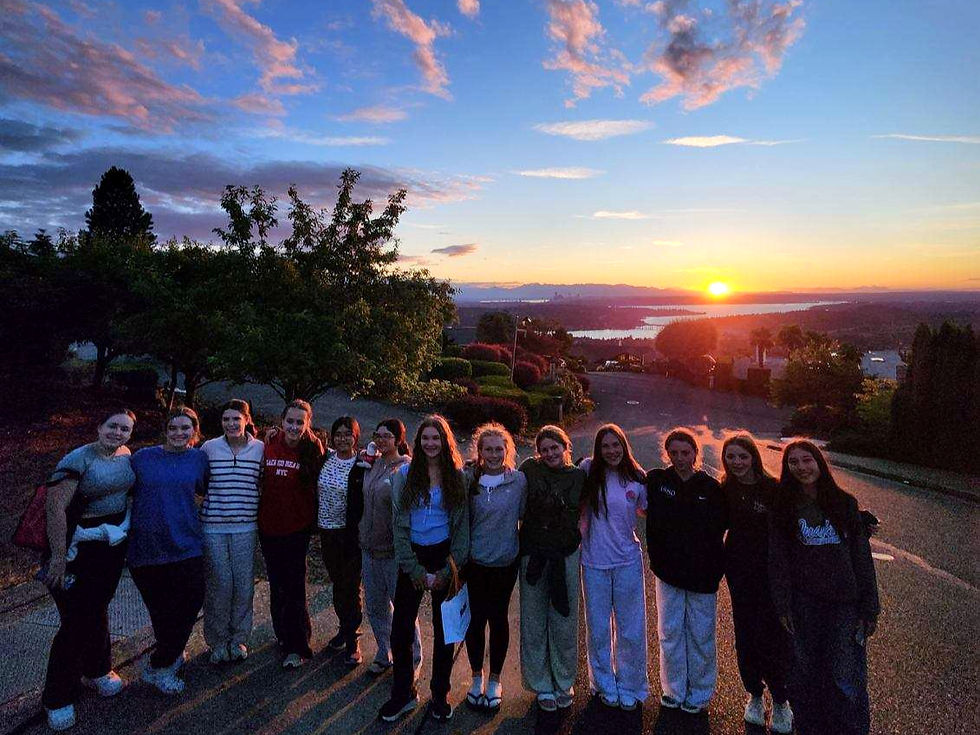
For fourteen students from nine Sacred Heart Network schools across the country, the answer was an unforgettable week of cultural exchange, environmental stewardship, and hands-on learning across western Washington.
Over six days, students traveled from Seattle through the Olympic Peninsula and into the Nisqually River watershed, where Coast Salish cultural educators, environmental scientists, and conservation leaders became their teachers. Along the way, they met tribal community members, explored ancient temperate rainforests, participated in salmon habitat restoration, and discovered how Coast Salish culture and stewardship have shaped—and continue to sustain—the lands and waters of the Pacific Northwest.
Built around Global Family Travels' Learn, Serve & Immerse philosophy, this educational journey in Washington State demonstrates how travel can foster meaningful cultural connections, environmental responsibility, and a deeper appreciation for the living traditions of Coast Salish communities.
Student Highlights from Our Coast Salish Adventure
Every student came away with different memories and lessons from this journey. The reflections below, compiled by lead Instructor, Corina , from student journals and group discussions, capture the experiences that resonated most—from learning directly from Coast Salish cultural educators to restoring salmon habitat and exploring Washington's incredible landscapes. The highlights are ordered in how their Global Family Travels’ student adventure unfolded:
1. Crossing Puget Sound on Seattle's Historic Ferry System
For thousands of years, the waters of Puget Sound have served as the lifeblood of Coast Salish communities, connecting villages, providing abundant fishing grounds, and supporting trade and cultural exchange. Today, the Washington State Ferry system follows many of these historic waterways, offering students a unique opportunity to begin their journey by experiencing the same marine landscape that has shaped life in the Pacific Northwest for generations.
Student perspectives:
As we departed Seattle aboard one of Washington State's iconic ferries, we watched the city's skyline slowly fade behind us while the forested shores of the Olympic Peninsula came into view. This historic ferry route, in service since 1922, offered spectacular views of Puget Sound and gave us a chance to appreciate the waterways that continue to connect communities across western Washington.
It was the perfect beginning to our adventure and a beautiful reminder that sometimes the journey itself can be just as memorable as the destination.

2. Become a Citizen Scientist While Assessing Local Water Quality for Salmon
Healthy salmon are at the heart of both the Pacific Northwest ecosystem and Coast Salish culture. During this hands-on science experience, we discovered how environmental stewardship, citizen science, and Indigenous knowledge all work together to protect the rivers that sustain salmon and the communities that depend on them.

Student perspectives:
We worked alongside scientists and volunteers at the Dungeness River Cultural Center to collect and identify aquatic macroinvertebrates—better known to us as "big water bugs!" These tiny creatures help scientists measure water quality and determine whether a river is healthy enough to support salmon.
We also had the opportunity to meet Loni Grinnell-Greninger, Vice Chairwoman of the Jamestown S'Klallam Tribe. The S'Klallam tribe has a long history with the river, and the health of the waterway is not only important for the salmon that swim through it but also to preserve the importance of the treaty-guaranteed fishing rights.
It was amazing to see how science, conservation, and Coast Salish culture and stewardship initiatives are deeply connected.
3. Coast Salish Culture on the Water: Paddling a Traditional Salish-style Canoe on Lake Crescent

Nestled within Olympic National Park, Lake Crescent is renowned for its crystal-clear waters, dramatic mountain scenery, and rich natural and cultural history. As part of Global Family Travels' Coast Salish Culture & Environmental Stewardship Adventure, students experience the lake from a unique perspective by paddling a traditional Salish-style canoe. Along the way, they discover how Indigenous stories, teamwork, and the natural environment come together to deepen their understanding of the Pacific Northwest.
Student perspectives:
Today at Nature Bridge, we had the opportunity to paddle a traditional Salish-style canoe on Lake Crescent. While out on the water, we experienced natural features like Echo Rock and the mysterious skeleton trees, all while working together as a team to maneuver the canoe.
Most notably, we learned of the lake’s long history and how it connects to Indigenous identity and culture. One of the stories shared with us tells how a giant buried members of the S'Klallam and Quileute tribal peoples in a landslide, creating the lake. Learning the stories connected to this landscape gave the scenery around us a whole new meaning and made the experience even more memorable.

4. Learning from the Makah Cultural Educators Through Hands-on Experiences
While our journey is centered on Coast Salish culture, students also learn from neighboring Indigenous communities, including the Makah Tribe, whose maritime traditions and stewardship of Washington's Pacific coast offer important perspectives on the region's diverse heritage. During a visit to the Makah Museum and Cultural & Research Center, students explore the Makah Tribe's rich maritime heritage, traditional ecological knowledge (TEK), and enduring connection to the Pacific Ocean through engaging exhibits and hands-on cultural experiences.
Student perspectives:
We arrived at the Makah Museum and Cultural & Research Center, where a Makah cultural educator led us through the galleries and introduced us to the Tribe's history and traditions. We learned about traditional whaling and fishing practices, the tools used to harvest food from the sea, and the deep spirituality woven into these traditions.
We also visited a traditional Makah longhouse before exploring the ethnobotanical garden, where we discovered native berry varieties and learned how important local plants have been to the Makah people for food, medicine, and everyday life.
To conclude our visit, we participated in a hands-on cedar weaving activity, creating bracelets and anklets under the guidance of an expert Makah weaver. It was a memorable way to experience a cultural tradition that has been passed down through generations.

5. Hike Cape Flattery with a Makah Cultural Guide
Learning about Makah history and traditions didn't end at the museum. Students continued their cultural journey with a guided hike to Cape Flattery, the northwesternmost point of the contiguous United States. Led by a Makah cultural guide, the experience brought the stories, traditions, and ecological knowledge shared at the museum to life while showcasing one of Washington's most spectacular coastal landscapes.
Student perspectives:
After our visit to the Makah Museum and Cultural & Research Center, we continued to Cape Flattery for a guided hike with a Makah cultural guide. The scenery was absolutely breathtaking, with rugged cliffs, sea caves, and endless views of the Pacific Ocean.
Along the trail, our guide shared traditional songs and stories that helped us better understand the Makah people's deep connection to this coastline. Experiencing the landscape through Indigenous perspectives made the hike even more meaningful and helped us connect the cultural traditions we had learned about at the museum with the place where they continue today.

6. Exploring Second Beach: The Natural Beauty and Indigenous Heritage of La Push
The wild coastline of Washington's Olympic Peninsula is one of the most spectacular landscapes in the Pacific Northwest. For the Quileute people, whose homeland includes La Push and the surrounding coastline, these beaches are far more than scenic destinations—they are places of deep cultural, historical, and spiritual significance.

Student perspectives:
After arriving in La Push, a coastal community on the western edge of Washington's Olympic Peninsula, we hiked through the forest to Second Beach, where we were greeted by dramatic sea stacks, driftwood, and the crashing waves of the Pacific Ocean.
We chose this location because of its beautiful and unique scenery! The trail was an extraordinary way to explore the natural beauty around us and to gain a deeper understanding of why the Quileute people value and care for these lands. The Quileute Tribe is based in La Push, and its ancestral homeland extends along the rugged Pacific coastline and inland toward Mount Olympus.
7. Exploring the Community of Forks: Where Nature, Coast Salish Culture & Community Meet
The Olympic Peninsula is home to vibrant communities whose stories are as fascinating as the landscapes that surround them. One of our first stops was Forks, Washington—the rainiest town in the continental United States! While many people know Forks as the setting for the Twilight series, we discovered so much more, from local history and culture to the welcoming people who call this unique community home.
Student perspectives:
We spent the day exploring Forks, Washington, visiting Twilight filming locations and supporting local businesses. We sampled Native American frybread at the Longhouse Café and learned about the history behind this important dish, whose origins reflect the resilience of Native communities during a difficult period in U.S. history. We also enjoyed burgers and ice cream at Sully's Drive-In and, of course, couldn't resist browsing the Twilight merchandise!
8. Walking among Giants as We Explored the Quinault Rainforest

Washington's Olympic Peninsula is home to one of the world's few temperate rainforests, where towering old-growth trees, lush mosses, and diverse wildlife create an extraordinary ecosystem. Much of this region is also the ancestral homeland of the Quinault Indian Nation whose enduring connection to these forests, rivers, and coastline has shaped the region for countless generations. Exploring the Quinault Rainforest gave our student group the opportunity to experience firsthand why protecting these ancient forests is such an important part of environmental stewardship in the Pacific Northwest.
Student perspectives:
Walking the Quinault Rainforest trail felt like stepping into another world. It was a swift, breezy walk with a light rain that somehow made the forest feel even more magical. This temperate rainforest is known as the "Valley of Giants" because of its enormous old-growth trees, some of the largest in the world.
As we walked beneath towering trees draped in moss, we learned about the native plants and animals that make this ecosystem so unique. Along the trail, interpretive signs helped us better understand how everything in the rainforest is connected. Experiencing this incredible place in person gave us a new appreciation for the importance of protecting these ancient forests for future generations.
9. Experiencing Coast Salish Culture Through Traditional Weaving Lessons with a Nisqually Tribal Member

Cedar is often called the "Tree of Life" by many Coast Salish people because it has provided materials for shelter, clothing, baskets, canoes, and ceremonial items for countless generations. As part of our adventure, students visited the Nisqually Cultural Center to learn directly from Nisqually cultural educators about the enduring significance of cedar weaving and its role in preserving Coast Salish traditions.
Student perspectives:
We spent the morning at the Nisqually Cultural Center, where we met Nisqually tribal members and learned about the importance of cedar in Coast Salish culture. After hearing about the history and traditions of cedar weaving, we broke into small groups to create our own woven cedar mats.
Taking part in a tradition that has been practiced for thousands of years was a very special experience. We were excited to bring home our woven cedar mats, but even more importantly, we gained a deeper appreciation for the skill, patience, and cultural significance behind this enduring Coast Salish tradition.

10. Restoring Natural Habitats Alongside the Nisqually River
A defining feature of Global Family Travels' Coast Salish Culture & Environmental Stewardship Adventure is giving students the opportunity to become active stewards of the places they visit. Working alongside the Nisqually Land Trust, students participate in hands-on habitat restoration while learning how healthy rivers, native plants, and salmon are interconnected. This service-learning experience demonstrates how even small actions can contribute to the long-term health of the Pacific Northwest's ecosystems.
Student perspectives:
We spent the morning with representatives from the Nisqually Land Trust who taught us about the restoration work they’ve done at a former raspberry farm on the Nisqually River. After getting our instructions we picked up our tools and went searching for the invasive Scotch broom. This plant changes the soil composition, making it nearly impossible for native plants to grow. Even though it rained on and off, we had a good time battling the plants – we mostly won!

We finished our time with the Nisqually Land Trust by playing Native Plant Bingo, where we learned to identify native plants and even tasted the root of a licorice fern. It really did taste like old-fashioned black licorice! By the end of the day, we realized that caring for the land isn't just something we learned about—it was something we had the chance to do ourselves.
11. Celebrating New Friendships and Eating S'mores Around a Campfire
While community service, cultural learning, and environmental stewardship are at the heart of this adventure, there's also plenty of time for fun, laughter, and building lasting friendships. Sharing experiences together—from paddling canoes and hiking coastal trails to restoring salmon habitat—creates memories that extend far beyond the classroom. Ending the journey around a campfire offered students a chance to reflect on their experiences, celebrate new friendships, and recognize how much they had grown through a week of learning, service, and adventure.
Student perspectives:
On our last night together, we gathered around a campfire to eat s'mores and share our reflections about the trip. We are so grateful for everything we learned, experienced, and, of course, for all the friends we made along the way during our epic road trip!
As we headed home, we realized we were taking away much more than great memories. We returned with a deeper understanding of the unique ecology of Washington's Olympic Peninsula, a greater appreciation for Coast Salish culture, and a newfound respect for the unique stories, traditions, and living heritage of the Indigenous communities who continue to call this region home.
Discover More Coast Salish Culture & Educational Adventures in Washington State
Looking for an educational travel experience that combines Indigenous perspectives, environmental science, service learning, and outdoor adventure?
Inspired by these student experiences? Global Family Travels believes travel has the power to inspire stewardship, foster cross-cultural understanding, and develop the next generation of compassionate global citizens.
Through our Learn, Serve & Immerse philosophy and regenerative tourism approach, we connect travelers with Indigenous communities, conservation organizations, and local changemakers to create meaningful educational experiences that benefit both visitors and the destinations they explore. Whether you're planning a school field study, educational travel program, or family adventure, our community-based experiences bring learning to life through authentic cultural exchange, hands-on service, and environmental stewardship.
From our Coast Salish Culture & Environmental Stewardship Adventure to our diverse collection of Seattle and Pacific Northwest experiences, every journey is designed to deepen understanding, inspire action, and create lasting connections.
Looking to extend experiential learning outside the classroom? Discover our Seattle & Pacific Northwest Educational Adventures and see how Global Family Travels can tailor a transformative experience for your school, organization, or family.
Thank you to the student and teacher contributions from the Sacred Heart Community who participated in this Coast Salish Adventure in Washington State!


Comments